By Analyst Team · Updated 2026-07-17 · 12 min read
You have probably heard the term "IPTV" thrown around in conversations about cord-cutting, streaming, and modern television. But what is IPTV TV exactly, and why is everyone talking about it in 2026? Put simply, IPTV stands for Internet Protocol Television. It is a system where television services are delivered over your internet connection instead of through traditional terrestrial, satellite, or cable formats. Think of it as streaming, but for live TV channels, on-demand movies, and even premium sports packages — all delivered directly to your TV, smartphone, tablet, or computer without needing a dish or a cable box.
This complete guide will explain how does IPTV work, break down the real benefits and honest limitations, compare it against old-school cable, and show you exactly how to get started. Whether you are researching the best IPTV service for Firestick, wondering about IPTV vs cable TV, or simply trying to understand the technology, this article answers every question you have about what is IPTV TV — without the hype or technical jargon.
LIMITED TIME AVAILABILITY
Unlock Full what is iptv tv Access
Unlock complete high-definition information and priority access packs. Lock in your pricing model today before plans return to standard regional metrics.
What Is IPTV TV? The Clear Definition You Need
At its core, what is IPTV TV is a method of delivering television content using the Internet Protocol (IP) network. Instead of broadcasting signals through radio waves (antenna), cables (cable TV), or satellite dishes (satellite TV), IPTV sends video content in packets over your broadband internet connection. The image above shows a typical setup: a family enjoying premium channels, live sports, and on-demand movies through a single IPTV interface on their smart TV.
There are three main forms of IPTV services: Live Television (broadcasts in real-time, just like traditional TV), Video on Demand (VOD) (where you pick and watch any movie or show from a library), and Time-Shifted Media (catch-up TV and start-over features). Many premium providers bundle all three into one subscription, giving you the flexibility of cable with the convenience of streaming. For example, the best IPTV service for Firestick will offer a unified interface where you can flip through live channels, browse an on-demand catalog, and even pause live TV — all without switching apps.
Related entities include IPTV providers (the companies that sell the subscriptions), IPTV players (apps like TiviMate, IPTV Smarters, or VLC that play the streams), and M3U playlists (the file format that contains the channel list and stream URLs). Understanding these pieces helps you answer the question "what is IPTV TV" not just as a concept, but as a practical tool for your home entertainment.
How Does IPTV Work? A Step-by-Step Explanation
Understanding how does IPTV work demystifies the technology and helps you choose the right setup. Here is the flow, broken down into simple steps:
Step 1: Content Acquisition and Encoding. The IPTV provider first obtains TV channels and content from broadcasters, content creators, or media companies. This raw video is then encoded into a digital format (typically H.264, H.265, or HEVC) that can be efficiently transmitted over the internet. The encoding process compresses the video so that even high-definition and 4K streams can travel without consuming massive bandwidth.
Step 2: Server and Middleware Infrastructure. The encoded streams are stored on powerful servers and managed by a middleware platform. The middleware is the brain of the operation — it handles user authentication, channel lists, electronic program guides (EPG), and VOD libraries. When you log into your IPTV app, the middleware verifies your subscription, loads your specific channel lineup, and presents the interface you see on screen.
Step 3: Content Delivery via CDN. The provider uses a Content Delivery Network (CDN) to distribute the streams closer to your geographic location. A CDN has thousands of servers around the world. When you request a channel, the middleware redirects you to the nearest CDN server. This reduces buffering, improves load times, and ensures stable playback even during peak hours. Premium services often have dedicated CDN servers in the United States, Europe, and Asia for optimal performance.
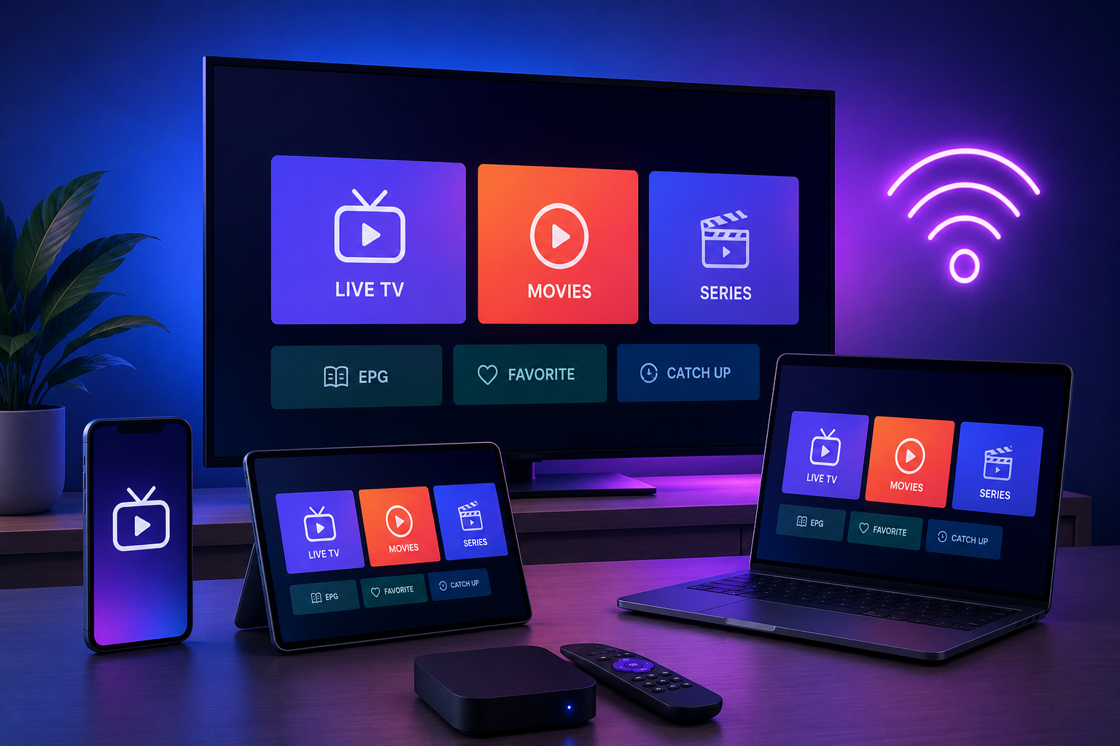
Step 4: Your Device and Player Application. On your end, you need a compatible device and an IPTV player app. This could be a Firestick, Android TV box, smart TV, smartphone, or even a computer running VLC. The player app receives the stream URL from the middleware, connects to the CDN, and begins decoding the video packets into the pictures and sound you see on your screen. The diagram below illustrates this complete chain from broadcast source to your living room.
Step 5: Real-Time Playback and Buffering. Unlike downloading a file, IPTV uses streaming technology — your player app downloads small chunks of video (typically 4-10 seconds) ahead of what you are watching. This "buffer" helps smooth out any momentary dips in internet speed. High-quality providers use adaptive bitrate streaming, which automatically adjusts the video quality (from 480p to 1080p or 4K) based on your current connection speed. This means if your WiFi gets slow, the stream will downgrade temporarily instead of freezing completely.
Secure special promotional rates instantly before the window closes.
Activate Your what is iptv tv Subscription Now →Concrete Benefits of Using IPTV in 2026
Why are millions of households switching from cable to IPTV? The benefits go far beyond just saving money. Here are the real, practical advantages that make what is IPTV TV an attractive option for modern viewers.
Massive Channel Selection Without Hardware Clutter. With cable, you need a set-top box for each TV in your home. With IPTV, a single subscription can provide thousands of channels across multiple devices simultaneously. You can watch on your living room TV, bedroom TV, tablet, and phone — all at the same time — without any extra boxes or wiring. IPTV services often offer extensive IPTV channels list USA packages that include local networks, sports, news, movies, and international programming, all accessible through one app.
Superior Flexibility and On-Demand Content. Traditional cable locks you into a rigid schedule. IPTV gives you control. Most premium providers offer catch-up TV (watch shows from the past 3-7 days), a VOD library with thousands of movies and series, and start-over features for live programs. If you miss the evening news or a live game, you can simply pull it up from the VOD section or rewind to the beginning — a feature that cable rarely offers without a pricey DVR rental.
Cost-Effectiveness. The average cable bill in the United States exceeds $120 per month before taxes and fees. A high-quality where to buy IPTV subscription typically costs between $10 and $25 per month, often including premium channels like HBO, Showtime, ESPN, and international packages. Even with a reliable VPN and a good internet plan, you are almost certainly saving 50% or more compared to cable.
Global Access and Portability. Whether you are traveling, living abroad, or simply away from home, IPTV works anywhere with an internet connection. Many expats rely on IPTV to access hometown news, sports, and shows from their home countries. This portability is a major advantage over cable, which is physically tied to your home address. The best IPTV service for Firestick is especially popular for travelers because the Firestick is small, portable, and runs the same IPTV app wherever you plug it in.
Honest Limitations You Should Know
While IPTV is excellent, it is not perfect. Being transparent about the downsides helps you make an informed decision. Here are the real limitations to consider.
Internet Dependency. IPTV is completely reliant on your internet connection. If your broadband goes down, you lose TV. This is a significant drawback for areas with unreliable internet. Cable TV, meanwhile, works even during internet outages (since it uses a separate coaxial infrastructure). You should expect to need at least 25 Mbps for stable HD streams and 50 Mbps for 4K content, especially if multiple devices are streaming simultaneously in your home.
Legal Gray Area. Not all IPTV services are created equal. Many unverified services offer access to copyrighted content without proper licensing, which is illegal in most jurisdictions. If you are wondering legal IPTV providers exist, yes — they do. Services like Hulu + Live TV, Sling TV, YouTube TV, and certain international providers are fully licensed. The challenge is that many cheaper, unauthorized services operate in a legal gray zone. If a deal seems too good to be true (like 10,000 channels for $10 a month), it is almost certainly an illegal service that could be shut down or compromise your data.
Potential for Buffering and Technical Issues. Even with a fast internet connection, poorly configured IPTV services can suffer from buffering, freezing, or low-quality streams. This often happens during peak viewing hours or major live events (like the Super Bowl or World Cup) when millions of users hit the same servers simultaneously. A reputable provider with robust CDN infrastructure minimizes this, but it is not eliminated entirely.
Lack of Standardization. Unlike cable, which has a standardized user experience across providers, IPTV interfaces vary wildly. Some players are clunky, poorly designed, or difficult to set up. You may need to tinker with settings, update M3U playlists, or configure EPG sources manually. It is not a "plug and play" experience for everyone — especially non-technical users.
IPTV vs Cable TV: Which Is Better?
The debate of IPTV vs cable TV comes down to your priorities: convenience versus control, cost versus reliability, and simplicity versus features. The table below compares the key factors side by side.
As the table shows, IPTV vs cable TV is not a one-size-fits-all answer. IPTV wins on cost, channel count, and flexibility. Cable wins on reliability, ease of setup, and legal clarity. Your choice depends on whether you value control and savings or simplicity and stability.
Who Is IPTV For? Real User Profiles
If you are still unsure whether IPTV suits your lifestyle, consider these typical user profiles that benefit most from the technology.
The Cord-Cutter. You are tired of paying $150+ per month for channels you never watch. You want a more affordable alternative that still gives you live sports, news, and entertainment. IPTV is the logical next step. You are willing to learn a new system in exchange for saving hundreds of dollars a year.
The International Viewer or Expat. You live outside your home country and want access to local channels, sports leagues, and shows from back home. For example, an American living in Germany who wants NFL games, CNN, and American network TV. IPTV services with international channel packages solve this problem effortlessly.
The Sports Enthusiast. You follow multiple sports leagues — NFL, NBA, MLB, Premier League, Champions League, UFC, F1 — and traditional cable packages make you pay for expensive sports tiers. IPTV services often include all major sports packages in a single subscription at a fraction of the cost. Many users consult IPTV review Reddit threads specifically to find providers with the best sports stream reliability and server stability during live events.
The Tech-Savvy User. You enjoy customizing your media experience. You are comfortable setting up an IPTV player app, configuring a VPN, and troubleshooting occasional buffering. You value control over your channel list and do not mind spending an hour to set up the perfect system. For you, how to set up IPTV on smart TV is a straightforward process you can complete in minutes.
The Parent on a Budget. You have multiple TVs and kids who watch different channels — cartoons on one, movies on another. A single IPTV subscription covers all devices simultaneously, eliminating the need for multiple cable boxes and their rental fees. The on-demand library also keeps kids entertained with movies and series without additional purchases.
How to Get Started with IPTV: 8 Practical Steps
Ready to try IPTV? Follow these numbered steps to go from curious to watching in under an hour. This guide assumes you want a reliable, enjoyable experience — not just the cheapest option.
Step 1: Evaluate Your Internet Connection. Run a speed test on the device you plan to use. You need a minimum of 25 Mbps for stable HD streaming. For 4K content or households with multiple simultaneous streams, aim for 50-100 Mbps. A wired Ethernet connection is always preferable to WiFi for IPTV, as it eliminates signal interference and provides consistent speeds.
Step 2: Choose Your Device. The most popular devices for IPTV are Amazon Firestick 4K Max, Nvidia Shield TV, Android TV boxes, and smart TVs running Android TV or webOS. The best IPTV service for Firestick will provide a dedicated app download or an M3U playlist that works seamlessly with Firestick-compatible players like TiviMate or IPTV Smarters Pro.
Step 3: Research Providers. Spend time reading IPTV review Reddit threads on subreddits like r/IPTVReviews or r/IPTV. Look for providers with active customer support, a money-back trial period (usually 24-48 hours), and positive long-term reviews. Avoid providers that demand six-month or yearly commitments upfront — a reputable service will offer monthly subscriptions.
Step 4: Consider a VPN. While not strictly required for legal IPTV providers, a VPN is highly recommended for privacy, security, and bypassing ISP throttling. Many internet service providers intentionally slow down streaming traffic. A VPN encrypts your traffic prevents this throttling, and also protects your data from unverified IPTV services that may log your activity.
Step 5: Install the IPTV Player App. On your Firestick or Android device, enable "Apps from Unknown Sources" in the settings. Download and install a reputable player: TiviMate (best interface, strong EPG support), IPTV Smarters Pro (simple and widely compatible), or VLC Media Player (free and open-source but less polished for live TV).
Step 6: Configure the Playlist. Your provider will give you either an M3U URL or an Xtream Codes API link. Open your IPTV player, navigate to the playlist or login section, and enter the URL or your credentials. The app will automatically download your channel list and EPG data. This process takes 30 seconds to 2 minutes depending on the size of your playlist.
Step 7: Set Up the Electronic Program Guide (EPG). The EPG gives you a visual TV guide showing what is currently airing and what is coming up. Most players require you to either link the provider's EPG URL or manually choose a source. A well-configured EPG transforms IPTV from a raw channel list into a polished cable-like experience. If you want to understand how to set up IPTV on smart TV specifically, most smart TV brands (Samsung, LG, Sony) have native IPTV apps available through their app stores or sideloading methods.
Step 8: Test and Optimize. During your trial period, test channels across different categories: sports, news, movies, and international. Check for buffering, audio sync issues, and guide accuracy. Adjust your player's buffer size (5-10 seconds is a good starting point) and enable hardware acceleration if available. Once everything runs smoothly, you are ready to enjoy your new IPTV setup.
Final Subscription Window:
Get Access Now Today →Affiliate Disclosure: Clicking this secure link verified by our network supports our team through standard partnership terms at zero extra cost to your invoice.
Frequently Asked Questions
Is IPTV legal in the United States in 2026?
Yes, IPTV technology itself is completely legal. The legality depends entirely on the content being streamed and whether the provider has obtained proper licensing for the channels they offer. Legal IPTV providers operate with proper broadcasting rights — services like Sling TV, YouTube TV, Hulu + Live TV, and licensed international providers are legitimate. Unverified services offering thousands of premium channels for a few dollars a month are typically operating without proper licensing, which is illegal. As a user, accessing copyrighted content without authorization could theoretically expose you to legal risk, though enforcement against individual consumers is rare. The safest approach is to use a reputable provider with transparent business practices.
What is the best IPTV service for Firestick right now?
The best IPTV service for Firestick depends on your needs, but the most consistently recommended providers among IPTV review Reddit communities include services like Apollo Group TV, Helix, and Nitro TV for their channel variety, EPG quality, and Firestick compatibility. Key features to look for include a native Firestick app or easy sideloading instructions, an accurate and responsive EPG, good server uptime (99% or higher), and responsive customer support. We recommend using the trial period offered by most providers to