By Analyst Team · Updated 2026-07-11 · 12 min read
[INSERT midCTA HERE]
LIMITED TIME AVAILABILITY
Unlock Full how does iptv work Access
Unlock complete high-definition information and priority access packs. Lock in your pricing model today before plans return to standard regional metrics.
Why Many People Regret Their IPTV Choice
You've heard about IPTV. Maybe a friend showed you how they watch every Premier League match in 4K for a fraction of what cable costs. Or you saw a Reddit thread raving about "the best IPTV service for live sports" with thousands of channels. The promise is tempting: hundreds of live channels, on-demand movies, and premium sports content for $10–$20 per month.
But here's the uncomfortable truth: thousands of people buy an IPTV subscription every week and regret it within 48 hours. The streams buffer constantly during the big game. The channel list looks nothing like the advertised screenshots. Customer support disappears after payment. And worst of all, some services shut down without warning, taking your money with them.
Understanding how does IPTV work on a technical level isn't just nerdy curiosity — it's your best protection against wasting money. When you know how the technology delivers video to your screen, you can spot red flags before you pay. You'll recognize which features actually matter for your setup and which are just marketing fluff. This guide exists to make you an informed buyer, not just another frustrated customer.
Criteria That Should Drive Your Decision
Before we dive into how IPTV streams video over the internet, let's establish the practical criteria you need to evaluate any service. These are the non-negotiable factors that separate a reliable subscription from a painful mistake.
Server Infrastructure and CDN Quality
IPTV works by sending video packets from a server to your device. If that server is overloaded or poorly connected, you get buffering. The best services invest in Content Delivery Networks (CDNs) with multiple server locations worldwide. Ask your provider directly: where are your servers located? Do you use a CDN like Cloudflare or custom infrastructure? A vague answer is a warning sign.
Channel Stability and EPG Accuracy
Nothing ruins the experience faster than a channel that goes offline during overtime. Reliable IPTV providers maintain 99%+ uptime on their channel lineup. They also provide an accurate Electronic Program Guide (EPG) so you know what's playing and when. Before subscribing, ask for a trial and test channels across different categories — sports, news, entertainment — during peak evening hours in your time zone.
Device Compatibility and Ease of Setup
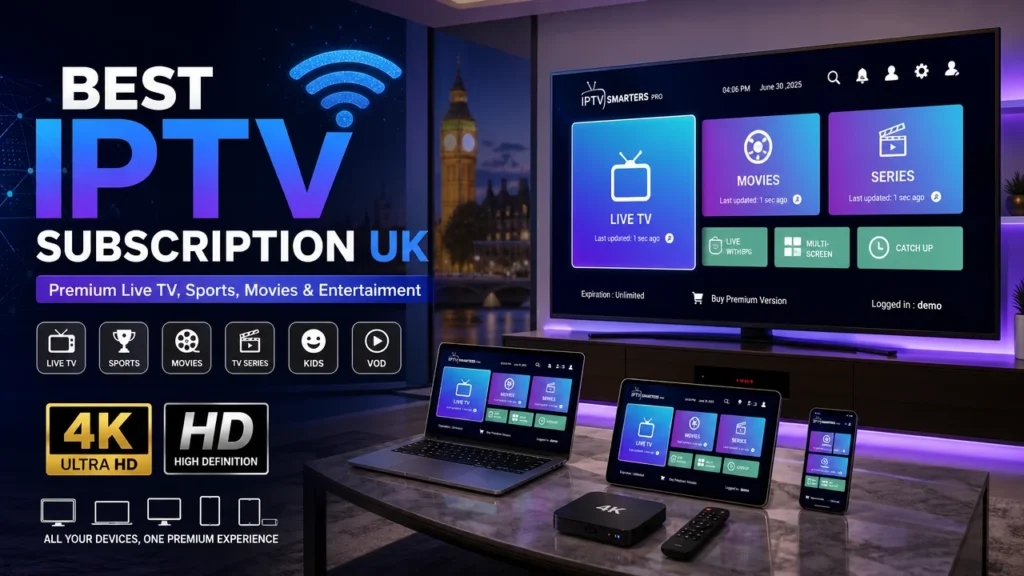
If you're wondering how to set up IPTV on Firestick or whether it works on your Samsung smart TV, compatibility matters enormously. Most quality services support Android TV, Fire TV, Apple TV, iOS, Android phones, and smart TVs through dedicated apps or third-party players like TiviMate and IPTV Smarters. A good provider should offer clear, step-by-step setup guides and responsive support for installation issues.
What You Need to Know About the Current IPTV Market
The IPTV landscape in 2025-2026 has matured significantly but remains fragmented. Here's what the market looks like right now if you're shopping for a subscription.
Pricing has stabilized. You'll find most reliable services charging between $12–$25 per month for a premium package with 8,000+ channels, VOD libraries, and 4K sports streams. Anything significantly cheaper often means compromised server quality or unstable streams. Anything much more expensive is likely retail arbitrage — someone reselling a basic service with a markup.
The legal gray area persists. The question "is IPTV legal in the US" doesn't have a simple yes or no answer. IPTV technology itself is completely legal. What matters is whether the provider holds proper licensing for the content they distribute. Legitimate services like YouTube TV, Hulu + Live TV, and Sling are licensed and above board. Many cheaper "reseller" services operate without proper licensing. We'll address legal considerations more thoroughly in the FAQ section.
Sports streaming drives the market. The biggest reason people switch to IPTV is live sports. The best IPTV service for live sports will offer dedicated sports packages with multiple feeds for leagues like NFL, NBA, EPL, La Liga, UFC, and F1. Look for services that provide 24/7 sports channels and match replays, not just live game streams that may or may not work during high-traffic events.
[INSERT secondCTA here]Secure special promotional rates instantly before the window closes.
Activate Your how does iptv work Subscription Now →Questions to Ask Before Buying an IPTV Subscription
Arm yourself with these questions before you contact any provider. The answers will immediately tell you whether the service is worth your time and money.
- Do you offer a free or paid trial? Any legitimate service has no problem giving you 24–48 hours to test their streams. If they refuse or make excuses, walk away.
- What bitrate do your sports channels stream at? A good service streams HD sports at 5-10 Mbps and 4K at 25+ Mbps. Lower bitrates mean pixelated action during fast movements.
- How many simultaneous connections does my plan include? If you plan to use IPTV on multiple TVs or devices in your home, you need a plan that supports 2-4 concurrent streams.
- What is your uptime guarantee or refund policy? Reputable services offer at least a 7-day money-back guarantee. Don't settle for less.
- Which payment methods do you accept? Avoid services that only take cryptocurrency or obscure payment apps. Credit cards and PayPal offer buyer protection.
Warning Signs to Spot Immediately
Scammers and low-quality IPTV resellers often follow predictable patterns. Train your eye to catch these red flags before you commit.
- Unrealistic channel counts. "50,000+ channels for $9.99!" is a lie. No provider offers that many unique, stable channels. They're counting variations and duplicates.
- No social media presence or community. Reliable services have active Telegram groups, Discord servers, or Reddit communities where users discuss issues. A ghost provider is a red flag.
- Aggressive upselling immediately after signup. If you're hit with "premium VIP" offers before you've even tested the basic service, they're trying to extract more money before you discover problems.
- Deleted negative comments. Check IPTV review Reddit 2025 threads and see if the service engages with criticism or deletes posts. Honest providers respond to feedback.
- No trial, no refund, no support. This trifecta means they expect you to be unhappy and want to make it impossible for you to complain.
Comparison Table of Available Options
To help you visualize the differences between common IPTV approaches, here's a direct comparison of the main categories you'll encounter.
| Feature | Premium Licensed Service (YouTube TV, Hulu) | High-Quality Reseller IPTV | Cheap Unverified IPTV |
|---|---|---|---|
| Monthly Price | $65–$85 | $12–$25 | $5–$12 |
| Channel Count | 100–200 (licensed) | 8,000–15,000 | 20,000+ (inflated) |
| 4K Sports Streams | Yes, consistent | Yes, reliable | Rarely works |
| Buffer During Peak Hours | Very rare | Minimal | Frequent to constant |
| Customer Support | 24/7 phone + chat | Telegram/email, responsive | None or bot only |
| Legal Protection | Fully licensed | Gray area | Almost certainly unlicensed |
| Money-Back Guarantee | 7–30 days | 7–14 days | None |
Recommendation by Budget and Needs
Your ideal IPTV setup depends heavily on your priorities. Here's how we'd advise different types of buyers based on common scenarios.
👍 Pros
- Massive channel selection for sports fans
- Cost-effective compared to cable bundles
- Works across multiple devices in your home
- No long-term contracts required
- VOD libraries with recent releases
👎 Cons
- Legal gray area can cause service interruptions
- Quality varies dramatically between providers
- Requires stable internet (25 Mbps minimum)
- Less polished user interface than cable
- Support can be slow during peak hours
Budget Buyer (Under $15/month)
If you're on a tight budget, focus on finding a service that offers a reliable base package rather than chasing huge channel counts. Look for providers with 5,000–8,000 channels that include your must-have sports channels. Skip services that promise everything for $5 — they will fail you during the Super Bowl or Champions League final. A solid middle-ground option in this range will give you HD streams, a decent EPG, and responsive Telegram support.
Sports Enthusiast ($20–$30/month)
If you're primarily searching for the best IPTV service for live sports, allocate a slightly higher budget. You need a provider that prioritizes sports server capacity, offers multiple source options for each game, and streams in at least 1080p60 for smooth motion. The extra $5–$10 per month often means the difference between watching the fourth quarter without issues or missing the game-winning play to buffering.
Family or Multi-Device User ($25–$40/month)
Households where 2–4 people watch different channels simultaneously need to focus on multi-connection plans. A single-connection plan won't work when someone wants sports in the living room while someone else watches cartoons in the bedroom. The best services allow 4 simultaneous connections without throttling. Consider whether you need an EPG that covers all time zones and parental controls for kids' channels.
How to Maximize Your IPTV Investment
Once you've chosen your subscription, these strategies will help you get the most reliable experience possible.
Use a wired connection where possible. Ethernet consistently outperforms Wi-Fi for IPTV. If your smart TV or Firestick is near your router, connect it with a cable. This single change eliminates 80% of buffering issues for most users. If you must use Wi-Fi, ensure you have a strong 5 GHz signal in the room where you watch.
Implement our IPTV buffering fix guide: Many buffering problems are actually on your end. Lower your player's buffer size setting to 1–3 seconds for live channels (reduces delay) and increase it to 10–15 seconds for VOD content (prevents stuttering). Use a VPN if your ISP throttles streaming traffic — some internet providers intentionally slow down IPTV streams. A quality VPN with obfuscation servers can bypass this throttling entirely.
Invest in a premium IPTV player app. Free players work, but apps like TiviMate (Android TV), GSE Smart IPTV (iOS), or IPTVX (Apple TV) offer far better EPG integration, parental controls, and stream management. Spend the few dollars on the premium version — it transforms a mediocre IPTV experience into a polished one.
Keep a backup list of providers. Even the best services occasionally have downtime for maintenance. Maintain relationships with 2–3 providers. This doesn't mean paying for all of them simultaneously, but having a trial code or a month-to-month second subscription ready ensures you always have access to your channels.
Final Subscription Window:
Main Offer Today →Affiliate Disclosure: Clicking this secure link verified by our network supports our team through standard partnership terms at zero extra cost to your invoice.
Frequently Asked Questions
How does IPTV work on smart TV compared to a regular cable connection?
IPTV on a smart TV works by installing an app (like IPTV Smarters or TiviMate) that connects to your provider's server over your home internet connection. Unlike cable, which broadcasts all channels simultaneously over coaxial cable, IPTV only sends the specific channel you're watching. This makes it more bandwidth-efficient but dependent on your internet speed. Most modern smart TVs from Samsung, LG, and Sony support IPTV apps directly from their app stores.
What is the best IPTV service for live sports in 2025 with minimal buffering?
The best IPTV service for live sports prioritizes dedicated sports server clusters, multiple source options for each game, and a robust CDN to handle traffic spikes during major events like the Super Bowl or Champions League final. Look for providers that offer 24/7 sports channel access, match replays, and bitrate options up to 25 Mbps for 4K streams. Always test with a trial during a live game you care about before committing.
How to set up IPTV on Firestick without getting errors or connection issues?
To set up IPTV on Firestick, first enable "Apps from Unknown Sources" in Developer Options. Download the Downloader app, then use it to install your provider's recommended application (often IPTV Smarters or TiviMate). Enter the portal URL, username, and password your provider gives you. For optimal performance, clear the Firestick cache weekly, maintain at least 500MB free storage, and use a VPN if your ISP throttles IPTV traffic.
IPTV vs cable which is better for picture quality and reliability?
Cable traditionally wins on reliability because it's a dedicated broadcast medium not shared with other internet traffic. However, premium IPTV services with strong infrastructure now match or exceed cable picture quality, especially in 4K where cable often compresses heavily. IPTV offers more channels and flexibility, but its reliability depends entirely on your internet connection speed and the provider's server quality. Cable provides consistent 1080i without buffering; IPTV offers variable quality but greater content variety.
Is IPTV legal in the US or can I get in trouble for using it?
IPTV technology itself is completely legal in the United States. The legality depends on whether the service provider holds proper licensing for the content they distribute. Services like YouTube TV, Hulu + Live TV, and Sling are fully licensed and legal. Unverified reseller services that offer premium channels without proper licensing operate in a legal gray area. As